
How to Develop Mathematical Thinking for Olympiad Problems
Preparing for a Maths Olympiad is very different from preparing for a regular school mathematics examination. Olympiad mathematics is not simply about knowing more formulas or completing calculations quickly. It is about learning how to think mathematically, recognise hidden patterns and approach an unfamiliar problem from different directions.
Students preparing for competitions such as IOQM, RMO, INMO and International Mathematical Olympiad (IMO) therefore need to develop strong mathematical thinking and Olympiad problem-solving skills alongside their regular mathematics studies.
What Is Mathematical Thinking in Olympiad Maths?
Mathematical thinking means understanding why something works instead of only remembering how to use a formula.
In school mathematics, a student may identify a chapter, recall the relevant formula and solve the question. In a Maths Olympiad problem, the method may not be obvious. A single question can require ideas from different areas of mathematics or an unusual application of a familiar concept.
This is why successful Olympiad Maths preparation should train students to analyse, experiment, observe patterns and develop their own approaches.
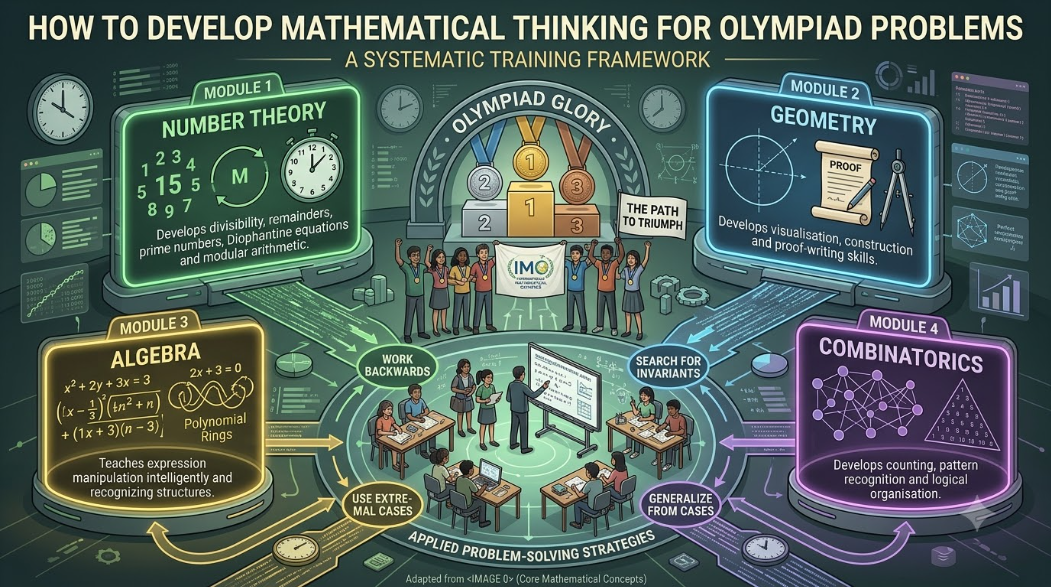
The major areas of mathematical Olympiad preparation include Algebra, Geometry, Number Theory and Combinatorics, according to the official HBCSE Mathematical Olympiad syllabus.
Learn to Ask the Right Questions
Whenever you see a difficult Olympiad problem, do not immediately search for a formula. Instead, ask:
What information has been given? What exactly needs to be proved or found? Can the problem be simplified? Is there a pattern? Can I test smaller cases? Can I represent the problem using a diagram, table or equation?
These questions gradually develop logical reasoning in mathematics.
For example, if a problem involves a sequence of numbers, calculate the first few cases and search for a pattern. If it is a difficult geometry problem, redraw the figure and look for equal angles, similar triangles, cyclic quadrilaterals or additional constructions.
The objective is not merely to reach the answer. The objective is to understand the structure hidden inside the problem.
Learn to Stay With a Difficult Problem..
One of the most important habits in Maths Olympiad preparation is learning to stay with a difficult problem.
Students sometimes read the solution after trying for only a few minutes. This may help them understand that particular question, but it does little to develop independent mathematical thinking.
Give yourself enough time to explore different possibilities. Even an unsuccessful attempt teaches you something about the problem.
When you finally read the solution, do not simply memorise it. Ask yourself why that particular idea worked and whether another solution could be possible.
For advanced stages such as RMO and INMO, this becomes even more important because students are expected to produce detailed mathematical proofs rather than simply provide final answers. For example, the 2026 RMO consists of six questions requiring detailed proofs.
Build Strong Foundations, Then Learn to Connect Ideas
Good Olympiad problem solving comes from strong fundamentals. Students should be comfortable with school-level mathematics before moving towards advanced Olympiad problems.
The real improvement happens when students begin connecting these ideas instead of treating them as isolated chapters.
Develop the Habit of Finding More Than One Solution
After solving a problem, ask yourself:
“Can I solve this another way?”
A geometry problem might also have an algebraic solution. A counting problem might be solved using both direct counting and complementary counting. A number theory question might reveal an unexpected pattern when represented differently.
Finding multiple approaches develops creative mathematical thinking, which is one of the strongest skills a student can build for Olympiad mathematics.
Mathematical Thinking Takes Time
There is no shortcut to becoming good at Olympiad Mathematics.
Solving hundreds of routine questions quickly is often less valuable than spending meaningful time understanding a smaller number of challenging problems. The objective should be to become comfortable with questions where the solution is not immediately visible.
With consistent exposure to Olympiad Maths questions, strong conceptual foundations and regular analysis of solutions, students gradually learn to recognise patterns and construct original arguments.
That is the real purpose of Maths Olympiad preparation: not simply learning more mathematics, but learning how to think like a mathematician.