
How to Teach Basic Math for Class 1 at Home
Let us be honest: the moment your child enters Grade 1, a little bit of math anxiety often comes into the household, and usually it is the parents who feel it first. We want our children to do well. We often worry that we are not teaching math to our children the right way.
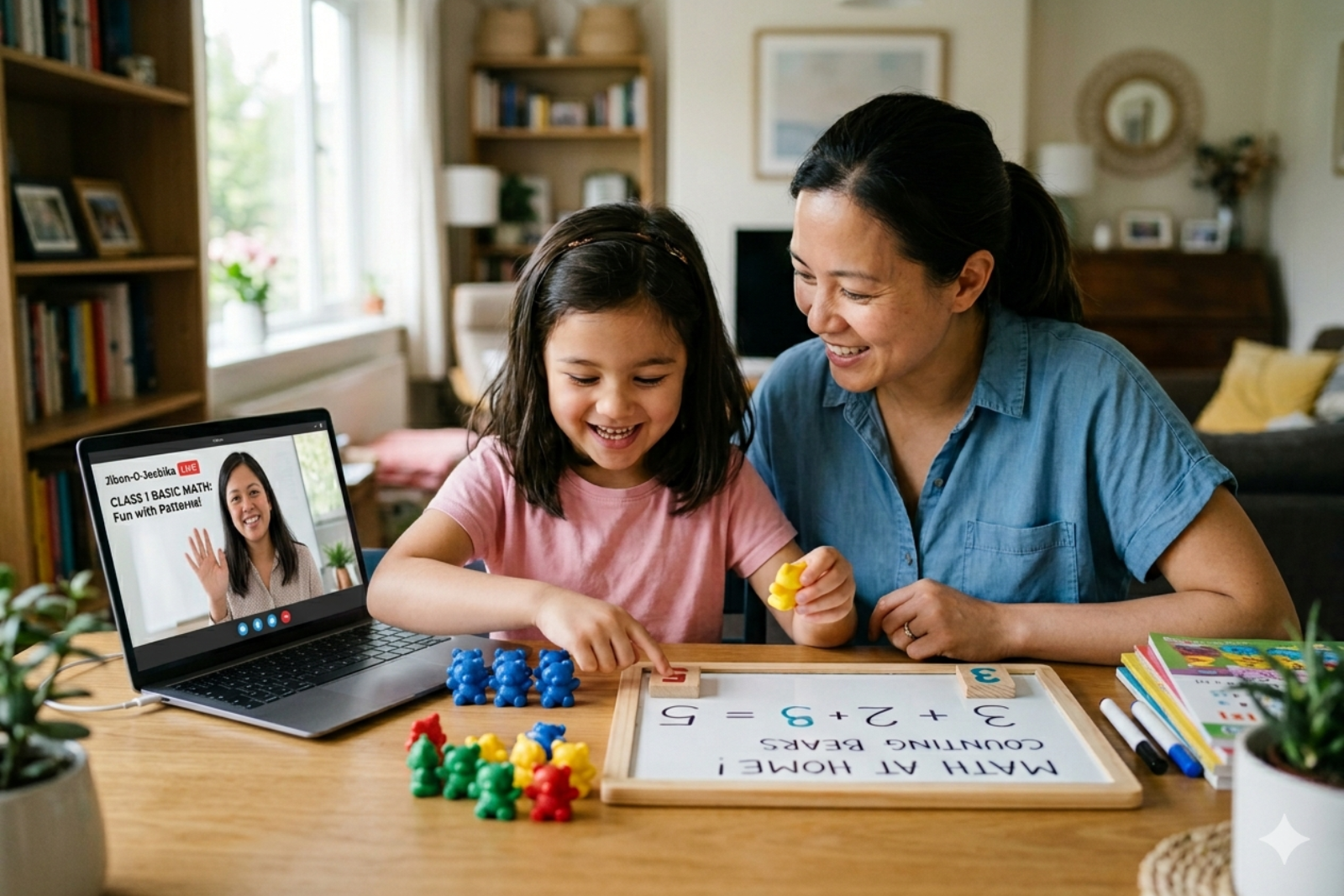
The truth is, your home is a better place for our children to learn than any school desk. At this age, math is not about memorising formulas; it is about seeing the patterns in the world around our children. If you are wondering how to teach math for Class 1 at home, the secret lies in moving away from boring worksheets and moving toward hands-on exploration with our children and math. We can help our children learn math and have fun with math at the same time.
Building the Core: Number Sense and Beyond
Before a child can really get addition, they need to know what numbers are about. This is what teachers call Number Sense. It is the difference between a child saying “1 2 3” because they learned it by heart and a child understanding that the number “3” means they have three apples on a plate.
To help a child build Number Sense and counting up to 100, you should start with things. You can use things like beans, colourful buttons or even Lego bricks that they like. Get your child to put these things into groups of ten. When they see that ten groups of ten make one hundred, the idea of a three-digit number is not so hard to understand. This way of learning by touching and feeling things helps create a picture of mathematics in their mind that they will remember forever.
Learning Through Play: The Power of Games
When you make math feel like a chore, a child’s brain will just shut down. If you make math a fun challenge, kids will really get into it, and they will become very good at math. The best way to keep kids engaged in math is to use fun math games for 6-year-olds. They will not even think that they are studying math.
At Jibon-O-Jeebika, we really like to do the “Home Grocery Store” activity. To do this, you need to set up some things from your kitchen, like food and other things and put price tags on them. Do not put many price tags; just a few will be okay. Then you give your child some play money. When they buy things, they are learning math like addition and subtraction in a way that feels real. They are learning basic math for class 1 in a way. Kids will see that math is not something you do in school, but it is something that helps you in your daily life, and it helps you get what you want. We use math to buy things we need. We use math to count our money. Math is really important. Kids will learn to like math if we make it fun.
Why Class 1 Math Matters for the Digital Future
You might think that adding numbers or finding a triangle is very different from the world of Artificial Intelligence. Artificial Intelligence is actually connected to these simple things. At Jibon-O-Jeebika, we think that teaching kids to see patterns and follow steps is the first step to understanding technology.
When a kid learns to sort clothes by colour or build with blocks from small to big, they are learning to think specifically. This way of thinking is important for learning to code. When they start to learn Python or Scratch, they will already know about “if-rules and how things are put together. Math is like a language that we will use in the future. At Jibon-O-Jeebika, we are just teaching kids the basics of math, like the alphabet, so they can learn more about Artificial Intelligence and technology later.
Daily Routine: Math in the Wild
You do not need a study time to learn. You can learn to teach math at home. Just talk about math in your life:
- In the kitchenyou can say, “I have four eggs. I need six eggs for this cake. How eggs do I still need?”
- When you are walkingyou can say, “What shape is that sign? Is it a hexagon or a rectangle?”
- At bedtimeyou can say, “It is eight o’clock now. We go to sleep at eight thirty. How minutes do we have left to read?”
By talking about basic math for class 1 in the your daily life you make it fun. Kids get curious, about math of being scared.
Conclusion
Teaching your child at home is not about being a teacher; it’s about being a helpful guide. Focus on why they’re learning not just how to do it. When your child makes a mistake don’t quickly fix it. Ask them “How did you get that answer?” This helps them think about their thinking.
With some patience and fun math games, for 6-year-olds math can become a part of your day. If you need help or support for your childs learning contact Jibon-O-Jeebika. We are here to help you with learning that focuses on skills.
FAQs
1. My child is struggling with counting past 20. Is this normal?
Absolutely. Many children hit a “plateau” at 20 because the naming convention changes. Keep practicing number sense and counting up to 100 using visual aids like a 100-chart to help them see the recurring patterns.
2. How much time should I spend on math each day?
For a 6-year-old, 15 to 20 minutes of focused “game-based” learning is plenty. Short, consistent bursts are much more effective than long, grueling sessions.
3. What are the best tools for teaching math at home?
You don’t need expensive kits. Use items like coins, measuring tapes, kitchen scales, and even a simple deck of cards for comparison games (Greater Than/Less Than).
4. How does Class 1 math relate to coding exactly?
Coding is essentially solving puzzles using logic. By focusing on foundational math for future coding skills, like symmetry and sequencing, you are teaching them how to break down large problems into smaller steps.
5. How can I help a child who says they “hate” math?
Stop using the word “math” for a week. Call it “The Snack Challenge” or “The Treasure Hunt.” Once the academic pressure is gone, their natural curiosity usually returns.