


Falling Behind in Class 11 Physics & Maths? Here’s How to Recover Before It’s Too Late
Scoring 90%+ in Class 10 Board exams often gives students and parents a strong sense of academic security. Yet, within the first three months of Class 11, scores frequently dip, homework piles up, and confidence drops.
If this sounds familiar, do not panic.
Falling behind early in Class 11 is normal—it does not mean your JEE ambitions are derailed. It simply means the study habits that succeeded in Class 10 no longer match the demands of Class 11. Here is why this transition happens and a structured blueprint to clear backlogs without falling further behind.
1. Why Class 11 Suddenly Feels Like a Wall
In Class 10, science and mathematics often reward direct formula application and memorisation. In Class 11, the syllabus shifts abruptly toward abstraction, visualization, and deep conceptual derivation.
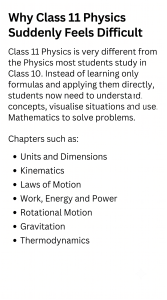
The Physics Shift: Application over Memorisation
Physics ceases to be about picking a formula and plugging in numbers. It requires:
Mathematical Tools First: Weakness in basic calculus, vectors, or graph reading derails subsequent chapters.
Chained Dependencies: Key mechanics chapters—Units & Dimensions, Kinematics, Laws of Motion (NLM), and Work, Energy & Power—form the bedrock for Rotational Motion, Gravitation, and Thermodynamics.
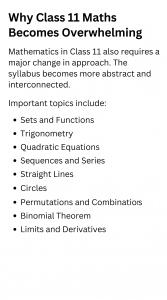
The Maths Shift: Interconnected Concepts
Maths becomes highly non-linear:
The Foundation Blocks: Sets & Functions, Trigonometry, and Algebra (Quadratic Equations, Sequences & Series) appear in every branch of JEE mathematics.
The Downstream Ripple: If trigonometry or coordinate geometry is shaky early on, Calculus (Limits & Derivatives) becomes impossible to master later.
2. The Anatomy of a Backlog: How It Begins
A backlog is rarely a sign of low capability; it is a breakdown of system and process:
Unclear Concept -> Skipped Practice Problems -> Low Mock Test Score -> Loss of Confidence
When confidence drops, students tend to avoid the tough chapters entirely and repeatedly revise only what they already know. To reverse this, you must break the backlog down into structured, bite-sized targets.
3. The 4-Step Recovery Framework
Step 1: Conduct a 3-Bucket Chapter Audit
Categorise every chapter completed so far into one of three buckets:
- Bucket A (Strong): Concepts are solid; you can solve standard JEE Main questions independently.
- Bucket B (Average): You grasp the theory, but get stuck on multi-step application problems.
- Bucket C (Critical/Weak): Fundamental concepts and derivations are unclear.
Immediate Priorities:
Step 2: Implement the 60–30–10 Study Rule
- 60% Current Topics: Ensures you remain current with your coaching and school lectures.
- 30% Dedicated Backlog Repair: Systematically work through high-weightage weak chapters.
- 10% Active Revision: Review core formulas, standard profiles, and past errors.
Step 3: Follow Graded Problem-Solving (Stop Jumping to Level 3)
Attempting advanced, multi-concept JEE problems before mastering the basics breeds frustration. Progress systematically:
Level 1 (Concept Building): NCERT examples, textbook theory, and basic direct questions to cement definitions.
Level 2 (Standard Application): Single-concept questions and standard JEE Main past-year questions (PYQs).
Level 3 (Advanced Integration): Multi-concept JEE Advanced problems and time-bound section tests.
Advance to the next tier only when you hit an 80% unassisted accuracy rate on the previous one.
Step 4: Maintain a 4-Column “Mistake Notebook”
Solving 50 new questions blindly is far less effective than thoroughly understanding 10 errors. For every mock test or problem set, log incorrect attempts under four heads:
| 1. Question Type & Source | 2. Nature of Mistake | 3. Core Missing Concept | 4. Missed Key Observation |
| e.g., Kinematics (Mock 2) | Conceptual vs. Calculation vs. Misread question | Formula/Theorem applied incorrectly | Shortcut, symmetry, or boundary condition overlooked |
Review this notebook once every week. Eliminating recurring patterns of mistakes drives faster score improvement than simply churning new problems.
4. Quality of Output vs. Study Hours: A Word for Parents
Measuring a student’s preparation solely by the clock (e.g., “He sits at his desk for 8 hours”) can be misleading. Long hours frequently mask fatigue, passive reading, or repetitive practice of easy topics.
- Track actionable deliverables instead of clock hours:
- Concepts fully understood and summarized without notes.
- Number of intermediate/advanced problems solved independently.
- Timely, detailed analysis of weekly test papers.
- Number of specific error patterns resolved from the Mistake Notebook.
A focused, 3-hour session with high problem-solving throughput delivers substantially more retention than an unstructured 8-hour marathon.
Key Takeaways
- Don’t wait for Class 12: Class 11 forms roughly 45%–50% of the JEE syllabus. Gaps left unaddressed now complicate final board and entrance prep.
- Test early, test weekly: Do not postpone tests until the syllabus is “fully finished.” The purpose of weekly testing is diagnostic, not validation.
- Fix the process, not just the hours: Systematically repair fundamental chapters using the 60–30–10 rule.
Quick Action Step for This Week
Take 20 minutes today to audit your current chapters into the Strong / Average / Weak buckets. Pick one foundational chapter from your Weak bucket (e.g., Vectors or Trigonometry) and allocate 45 minutes daily to it alongside your regular classes.