
Are Marks the Best Measure of a Student’s Learning?
A student can score 95% and still struggle to apply a concept in real life. Another may score 75% and yet think deeply, ask better questions, and solve problems creatively. So what are we really measuring?
For years, marks have been treated as the ultimate indicator of academic success. They are useful, but they are not the complete picture.
Examinations often measure memory, speed, accuracy, and performance under pressure. Real learning, however, also includes curiosity, critical thinking, creativity, communication, adaptability, and the ability to apply knowledge beyond the classroom.
Marks can tell us how a student performed on a particular day.

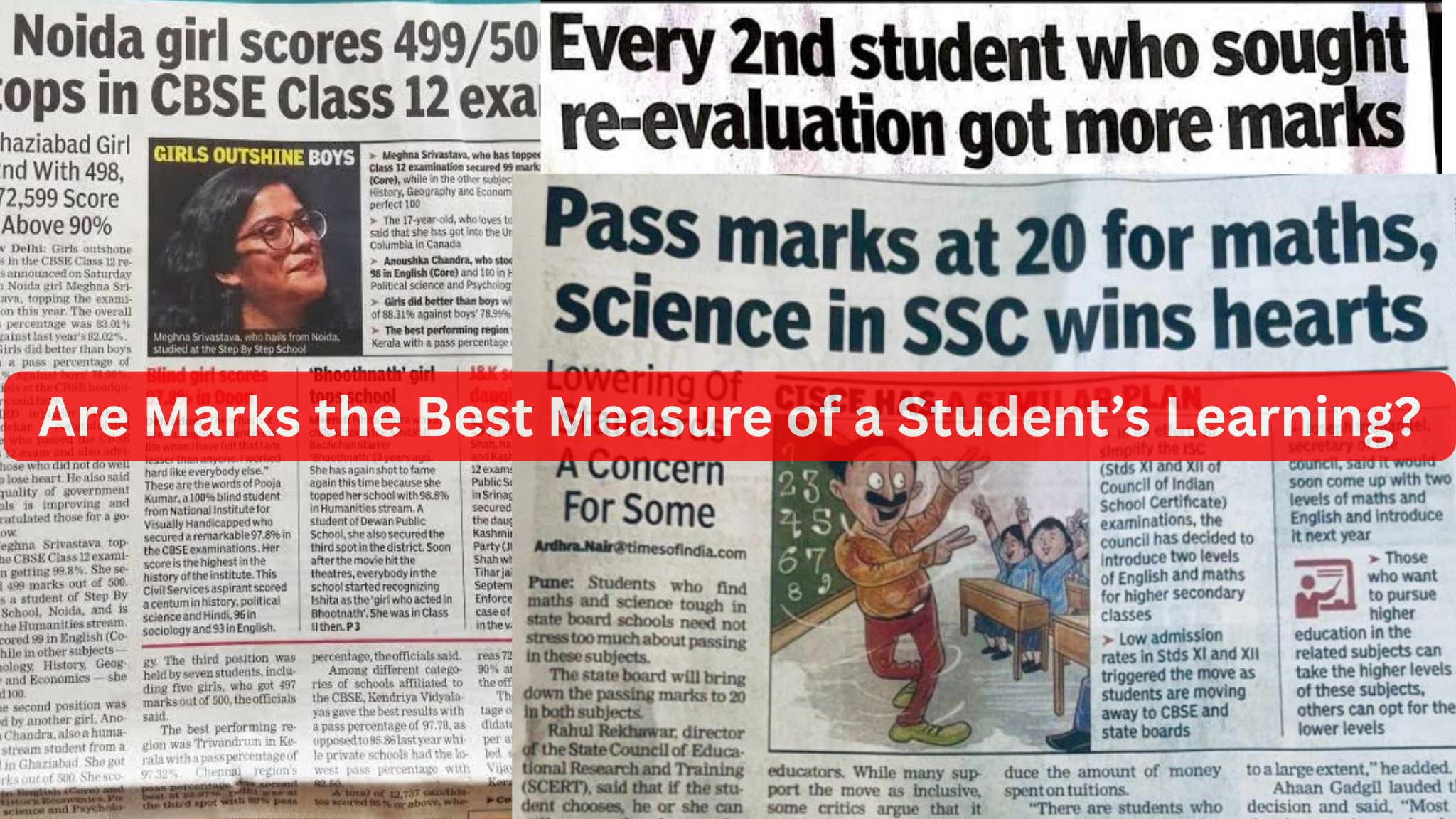
A student scoring an extraordinary 499 out of 500 and topping the CBSE Class 12 examination. Such achievement deserves appreciation, but it also makes us think about how narrowly we sometimes define success. When students score 98%, 99% or nearly 100%, the difference between them may be only one or two marks. Can those few marks truly tell us who understands better, thinks more creatively or will perform better in real life? A topper’s story should inspire us, but education should also recognise qualities that cannot always be captured on a mark sheet.

Here, the focus is on reducing pass marks in Mathematics and Science to ease pressure on students. For some learners, these subjects become a source of fear rather than curiosity. Lowering the passing requirement may give them a second chance to continue their education without being defined by one difficult subject. At the same time, it reminds us that the purpose of education should not simply be to make students pass or fail, but to help them understand, improve and discover where their real strengths lie.

The story of students who believed that their marks did not reflect their actual performance and decided to ask for re-evaluation. What followed was surprising: a large number of them received higher marks after their answer scripts were checked again. This raises a serious question—if a student’s score can change because of an evaluation error, can marks really be treated as the final measure of learning? Behind every mark sheet is a student, and sometimes even a small correction can change confidence, opportunities and academic direction.
Together, these three stories send one powerful message: marks matter, but they should never become the only definition of a student’s ability, intelligence or future.
They cannot always tell us how much that student has grown, how deeply they understand a subject, or what they may be capable of becoming.
The future will reward students who can think, question, create, collaborate, and solve unfamiliar problems—not simply reproduce the right answers.