

JEE Advanced 2026 Is Tomorrow. Here Is What You Should Actually Do Tonight.
Tomorrow is JEE Advanced 2026. May 17.
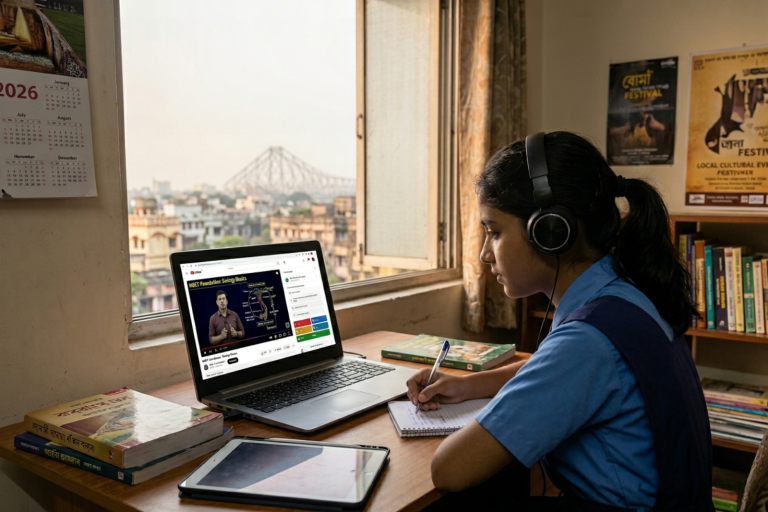
I’m going to keep this short and useful. If you’ve done the preparation, the worst thing you can do tonight is try to add to it. The best thing you can do is not damage what you’ve built. Those are two different goals, and they require two different approaches to this evening.
Tonight has one job
Don’t open a new topic. I’m not being general here. Even if there’s a chapter that makes you nervous, opening it tonight will not resolve that nervousness. What it will do is add uncertainty on top of everything that’s already in your head. Your two years of preparation are more complete than your anxiety is telling you right now. That’s almost always true the night before the exam.
Switch off any group chat or social media that has people sharing last-minute topics. Every year, students walk into JEE Advanced carrying someone else’s anxiety about a topic that doesn’t even appear on the paper. None of that content helps you. All of it costs you sleep.
The only revision that makes sense tonight is your own formula sheet. The one you wrote yourself, in your own words, with your own shorthand. Fifteen to twenty minutes on that. Then close everything.
Pack your bag before you sleep. Admit card printed, not on your phone. Valid photo ID. Two pens. Pencil. Geometry set if applicable. Water bottle. Light snack for the break between papers. Check the exam centre address and calculate your travel time, then add 30 minutes to that number. The gate closing time at JEE Advanced centres is not flexible.
Sleep by 10:30. A tired brain makes errors on problems it knows the answer to. You do not want to lose marks that way.
Tomorrow morning
Eat something for breakfast. It should be simple and not too filling. Your brain uses glucose during a three-hour exam. Skipping breakfast can really affect your performance. This has nothing to do with how you have prepared. Do not look at any study stuff in the morning. Do not check your phone for last-minute advice. Leave for the exam centre with plenty of time to spare. You want to feel calm when you get there, not stressed. How you feel in the first few minutes can affect how you tackle the first few questions.
Inside the paper
The JEE Advanced exam has two papers that you have to take on the same day. Each paper is three hours long. The JEE Advanced papers cover Physics, Chemistry and Mathematics. The questions in the JEE Advanced papers are of various types. You will see correct questions, multiple correct questions, numerical questions and paragraph-based questions. The JEE Advanced exam has a marking scheme for each type of question.
Read the instructions for each section before you start answering it. This sounds obvious, but students skip it under pressure and then realise mid-section that they misunderstood the partial marking rules. Two minutes spent reading the section instructions can protect the marks you’ve already earned through preparation.
The most common time mistake in JEE Advanced is getting stuck. A problem that hasn’t moved in four minutes is not going to move in eight. Mark it, go to the next question, and return with fresh eyes later. The paper is designed so that not every problem is solvable within every student’s time budget. The students who score well are the ones who quickly identify what they can solve and don’t allow the rest to eat into that time.
Physics
When a problem looks unfamiliar, break it down into what is physically happening. What forces are acting? What energy is being transferred? What is the constraint in the system? If you can answer those three questions, you usually have a way into the problem even if you haven’t seen its exact form before. Mechanics and Electromagnetism carry the most weight consistently. Optics and Modern Physics are more formula-driven and reward quick recall if you’ve revised them.
Mathematics
Find your fastest area within Maths first and build momentum there. Don’t start with the section that slows you down. Calculus problems in JEE Advanced often require combining two or three concepts. If you see a calculus problem and the method isn’t clear in 30 seconds, move on and come back. Coordinate geometry is a reliable scoring ground if you’re fluent. Combinatorics problems are either very fast or very long. Read them completely before committing.
Chemistry
In Physical Chemistry, calculation accuracy is your primary shield. Rushing an electrochemistry or thermodynamics problem only to make an arithmetic error is frustrating. You knew the concept, but the number was wrong.
For Organic Chemistry, mechanisms often appear in unfamiliar contexts. If you truly understand the “why,” you can work through them. If you relied on rote memorisation, novel contexts will trip you up. To ensure you have the conceptual clarity required for these problems, reinforcing your Class 12 JEE NEET Chemistry fundamentals is essential. Inorganic Chemistry is about recall; trust what you know. At Jibon-O-Jeebika, we emphasise that mastering these pillars requires logic over luck.
Between Paper 1 and Paper 2
This gap matters more than students typically account for. Go outside. Eat your snack. Drink water. Do not spend the break discussing Paper 1 with other students. You cannot change your Paper 1 answers, and replaying them in your head takes your mental energy away from Paper 2, which is a completely separate exam. Walk into Paper 2, treating it as such.
Conclusion:
If this is your first attempt and you’re using it primarily as a learning experience, own that decision. Some students walking into the hall tomorrow know their preparation wasn’t complete this year; they are there to understand the pressure, the environment, and the true depth of the questions. That is a legitimate, strategic reason to sit for JEE Advanced 2026, and you shouldn’t let anyone tell you otherwise.
Your goal tomorrow is to come out of that hall with specificity. Don’t just conclude that “Maths was tough.” Identify exactly what cost you marks: was it losing twenty minutes on a single integration problem you couldn’t execute under pressure? Was it the way Organic Chemistry looked in an unfamiliar context? This level of detail is exactly what a successful gap year is built upon.
The students who transform a weak first attempt into a top-tier rank the following year are those who treat the gap year as a structured process rather than an extended break. They start building their foundations in June, focusing on conceptual depth rather than just syllabus speed. At Jibon-O-Jeebika, we specialise in helping students bridge these exact gaps.
You’ve put two years of your life into tomorrow. Go do it justice, learn from every minute of it, and if you’re ready to build a stronger foundation for the future, Contact us at Jibon-O-Jeebika to see how we can help you succeed.
FAQs:
Q1: Is it worth studying a new formula or shortcut the night before JEE Advanced?
No, if you try to learn things tonight it will only make you feel confused and worried about JEE Advanced. JEE Advanced is not about remembering things at the moment it is, about really understanding the JEE Advanced concepts. So just take a minute, like 15 minutes to look at the JEE Advanced formulas you have written down yourself. Then close your books. Get some rest.
Q2: What should I do if I get completely stuck on the first few questions of Paper 1?
If you get completely stuck on the few questions of Paper 1, what should you do? Do not panic. The people who take the exam put questions at the start to see how you handle pressure. If you are stuck on a question for 60 to 90 seconds, just skip it. Move on to a part of the exam that you feel good about and find your rhythm. Then you can go back to the questions of Paper 1 later.
Q3: How should I utilize the gap between Paper 1 and Paper 2?
Take the break as a chance to clear your mind. Don’t think about Paper 1. Check your answers with friends because that will only make you tired and less focused for Paper 2. Get away from the crowd, have a snack, drink some water and start Paper 2 like it’s a new exam.
Q4: What are the absolute mandatory documents to carry to the JEE Advanced 2026 exam centre?
Make sure you have these items in your bag tonight: A printed copy of your Admit Card, A Photo ID, such as your Aadhaar Card. It has to be the original, not a photo copy. You will also need two blue or black ballpoint pens, a pencil, a transparent water bottle, Remember, your Admit Card and Photo ID must be copied. No digital copies on your phone are allowed.
Q5: What if I know my preparation isn’t enough to clear the cutoff tomorrow?
Do not skip the exam. Treat the exam tomorrow as a mock test under real pressure. This will help you see how you do when it really matters. Use this experience to find out where you are losing time and which questions are really hard for you. The things you learn from this are very important if you want to start and make a plan to do better next time. The exam tomorrow is like a test run to help you get better at clearing the cutoff.