
The Power of Storytelling in Education: How Stories Make Learning Memorable
Think back to your school days. You may have forgotten many definitions and formulas, but chances are you still remember a story your teacher once told.
That is the power of storytelling.
Stories Turn Lessons Into Experiences
Traditional teaching often focuses on facts, explanations and textbooks. Storytelling adds something different — emotion, imagination and context.
When a teacher connects a difficult concept with a relatable story, students are more likely to pay attention and understand why the lesson matters. Instead of simply receiving information, they begin to experience the idea.
Storytelling Improves Student Engagement
Stories naturally create curiosity. Students want to know what happens next.
Teachers can use stories, real-life examples, historical incidents, experiments or simple classroom situations to introduce concepts. Interactive storytelling can also encourage students to ask questions, participate in discussions and express their own ideas.
Stories Help Students Remember
This makes complex concepts easier to connect, understand and recall.
Storytelling can also encourage students to read more, improve listening skills and become more confident in speaking and writing.
From Storytelling to Story-Based Learning
Modern classrooms do not have to choose between academic rigor and engaging teaching.
A Physics teacher can tell the story behind a scientific discovery. A Chemistry teacher can explain an experiment as a journey of discovery. A Biology teacher can turn a chapter into the story of how a living system survives.
The subject remains the same — but the learning experience changes completely.
The Future Classroom Needs Great Storytellers
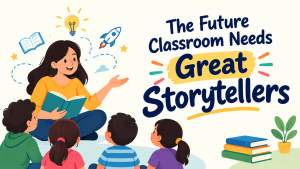
Technology and AI can provide students with unlimited information.
What teachers uniquely bring is the ability to connect information with curiosity, emotion and meaning.
And sometimes, the most powerful way to begin a lesson is not:
“Open your textbook.”
It is: