
The Psychology of Student Development: Beyond Academics
A student’s development cannot be measured by marks alone. Behind every examination score is a young mind dealing with confidence, motivation, stress, friendships, expectations, failure and the need to feel accepted.
Modern educational psychology increasingly shows that when schools focus only on academic performance, they may overlook some of the factors that actually make academic success possible.
Emotional Skills Can Influence Academic Performance
One of the largest studies in this area analysed 213 school-based Social and Emotional Learning (SEL) programmes involving 270,034 students.
Researchers found that students participating in SEL programmes showed improvements not only in emotional and social skills, but also in behaviour and academic performance. Most strikingly, their academic achievement showed an average 11-percentile-point improvement compared with students who did not participate.
Case Study 1: Learning to Manage Emotions
Imagine two equally intelligent students preparing for the same examination.
One becomes overwhelmed after receiving a poor test score and begins thinking, “I am simply bad at this subject.” The other has learnt how to recognise disappointment, seek feedback and make a new study plan.
Their academic ability may initially be similar. Their psychological response to failure, however, can eventually take them in very different directions.
The SEL research suggests that skills such as emotional regulation, decision-making and positive relationships should therefore be considered part of education—not extras added after academics.
Case Study 2: What Happens When Students Believe Ability Can Grow?
A major 2019 study published in Nature examined 12,490 ninth-grade students across 65 U.S. public schools.
Students received a short online intervention explaining that intellectual abilities can develop through learning, effort and effective strategies.
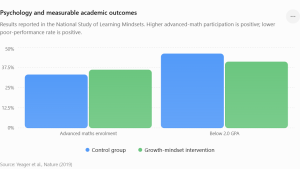
Among lower-achieving students, the intervention produced a measurable improvement in core-subject GPA. Researchers also found that enrolment in advanced mathematics increased from 33% to 36%. Among lower-achieving students, the estimated rate of very poor academic performance fell from approximately 46% to 41%.
The important lesson is not that telling children to “think positively” magically improves marks.
Rather, when students stop interpreting difficulty as proof that they lack ability, they may be more willing to attempt difficult problems, recover from mistakes and continue learning.
Case Study 3: The Power of Belonging
Academic development is also deeply social.
In a Stanford-led randomized study involving college students, researchers tested a brief intervention designed to reassure students that difficulties in fitting into a new academic environment are common and often temporary.
Over the following three years, the intervention improved academic outcomes for African-American participants and reduced the measured achievement gap in GPA by approximately 52% in that particular study. Participants also reported improvements in aspects of health and well-being.
The message for schools is powerful: a student who constantly wonders, “Do I belong here?” may use considerable mental energy dealing with that insecurity.
A classroom where students feel respected, accepted and safe to make mistakes can therefore become a better environment for learning.
What the Data Tell Us
Three findings are worth remembering:
- 270,034 students: SEL programmes were associated with an 11-percentile-point academic gain.
- 12,490 students: a brief growth-mindset intervention increased advanced mathematics participation from 33% to 36% and produced modest academic benefits, particularly in supportive school environments.
- Social belonging study: the intervention reduced the measured three-year GPA achievement gap by about 52% among the groups studied.
Suggested Graph Data
Growth-Mindset Study
| Academic Indicator | Control Group | Intervention Group |
| Advanced Mathematics Enrolment | 33% | 36% |
| Students below 2.0 GPA* | 46% | 41% |
*Estimated outcome reported for the lower-achieving group in the study.
Beyond the Report Card
Good education should certainly develop knowledge in mathematics, science, languages and other subjects. But it should also develop the person who is learning them.
Confidence without arrogance, resilience after failure, emotional control, curiosity, healthy relationships and a sense of belonging can influence how effectively a student uses academic ability.
Perhaps the better question is no longer simply:
“How much marks did the student score?”
It is also:
“What kind of learner—and what kind of person—is the student becoming?”
That is where student development truly goes beyond academics.